|
|
||||||||||||||||
Read Our Blog! |
|
Photographic Solution's ECLIPSE
and Pec-12 can only be shipped
by UPS (United Parcel Service) Ground. No Next Day, Second Day or 3 Day
select shipments are permitted. No shipments by US Postal Service.
No International Shipments of Eclipse or Pec-12.
|
Available June 2008! Pro Digital Survival Kit! Photographic Soultions expands their highly successful Digital Survival Kit line with the NEW Pro kit! Enclosed in a durable,high quality nylon zippered pouch are:
NOW ALSO AVAILABLE WITH E2! Available in each of Only $120.00!!! Shipping June 2008! Ships UPS Gound ONLY! |
|
|
Photographic Solutions announces NOW SHIPPING on the new E2 (Eclipse 2) cleaner for use with the new Sony Alpha and Canon 400D/XTi Tin Oxide coated sensors. Click Here to see the list of cameras that take ECLIPSE and the cameras that take ECLIPSE 2. ECLIPSE 2 (E2) for TIN OXIDE SensorsECLIPSE 2, the highest purity Tin Oxide sensor cleaner, is now available, containing less than 5 parts per million (ppm) of contamination (the whitish residue left after evaporation). ECLIPSE 2 dries as quickly as it can be applied leaving absolutely no visible residue, making it the only recommended cleaner for Indium Tin Oxide coated CCD's and CMOS sensor cleaning when used with SENSOR SWABS.In fact, Eclipse E2 is recommended by SONY for cleaning their DSLR CCD sensor when used with SENSOR SWABS. Photographic Solutions states, "We are pleased that Sony has been added to our list of manufacturers recommending our cleaning fluid and swabs. No other sensor cleaning products to our knowledge have ever been recommended by ANY camera manufacturer!" -- 2007 NOTE: Due to the classification of this product, we can ship UPS Ground only (within the US). |
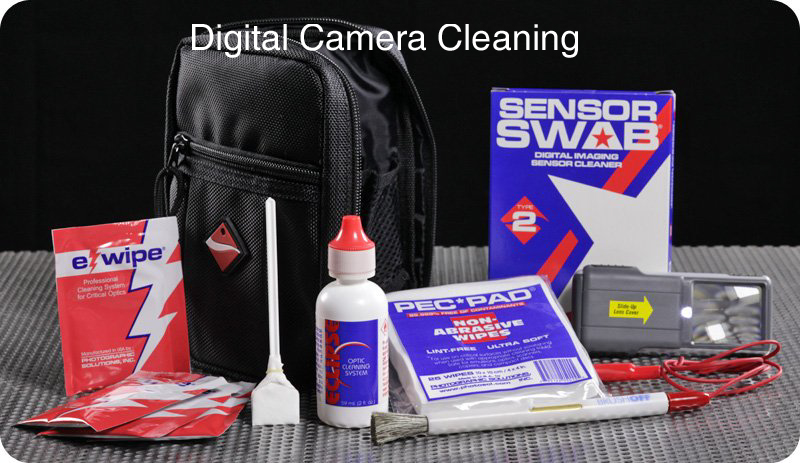
Also from Photographic Solutions, the new DIGITAL SURVIVOR KIT. It's all you need to keep your high-end camera sensors and optics clean while on the road. The kit comes in a nylon pouch which as a belt loop on the back side. Kit includes: NOW ALSO AVAILABLE WITH E2! Available in each of Ships UPS Gound ONLY! |
| Product |
Item |
Quantity |
Manufacturer Suggested Retail Price |
Our |
Add |
|
|
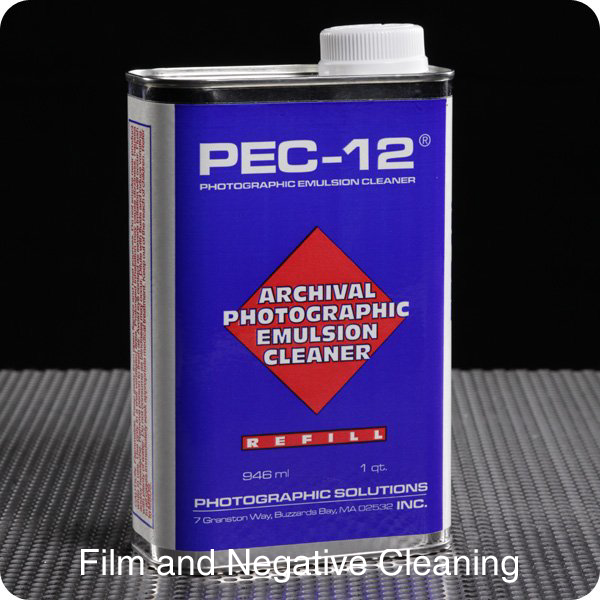
Pec-12PEC-12 Photographic Emulsion
Cleaner for color & black and white prints, slides and negatives.
PEC-12 removes ink, finger oils, adhesives, mildew
and other non-water based stains. PEC-12 is ARCHIVAL-SAFE.
PEC-12 should be purchased along with the PEC*PADS below. MSDS Sheet
- Word |
54181 |
4 oz. |
$14.00 |
$11.95 |
|
| 54182 |
1 qt. |
$70.00 |
$60.00 |
|||
![]() |
PEC-PADS 4" x 4"Package of 100 Pec-Pads |
51570 |
100 |
$8.25 |
$7.95 |
|
PEC-PADS 4" x 4"Case of 1200 Pec-Pads |
51573 | 1200 Pec*Pads |
$75.00 | $72.00 | ![]() |
|
| 51572 |
25 |
$8.25 |
$7.95 |
|||
![]() |
NOTE: Due to the classification of Eclipse, we can ship UPS Ground Only. Eclipse Optical Cleaning System is ideal for all optical mirrors, lenses and filters. Eclipse dries instantly with no residue. For a complete list of cameras that require Eclipse or Eclipse 2, Click Here Read a discussion on Leica Camera's Forum: DMR
SENSOR CLEANING about using ECLIPSE and SENSOR
SWABS |
51578 |
2 oz. cleaner & applicator tip |
$9.50 |
$8.95 |
|
|
Specifically engineered to work NOTE: Due to the classification of Eclipse, we can ship UPS Ground Only. |
51582 |
2 oz. cleaner & applicator tip |
$9.50 |
$8.95 |
|
| SENSOR SWABS (Type
1) See Cleaning Procedure for an illustration of how to use Eclipse & Sensor Swabs. Alternatively, you can purchase a Digital Survival Kit, Type 1, 2 or 3 - see below.
|
51575 |
12 |
$45.00 |
$42.95 |
||
|
Note: Eclipse & Sensor Swabs work together to clean camera CCD chips & must be purchased together if you do not already have Eclipse. See Cleaning Procedure for an illustration of how to use Eclipse & Sensor Swabs. Alternatively, you can purchase a Digital Survivor Kit, Type 1, 2 or 3 - see below.
|
51576 |
12 |
$45.00 |
$42.95 |
||
SENSOR SWABS (Type 3)Note: Eclipse & Sensor Swabs work together to clean camera CCD chips and must be purchased at the same time if you do not already have Eclipse. See Cleaning Procedure for an illustration of how to use Eclipse and Sensor Swabs. Alternatively, you can purchase a Digital Survival Kit, Type 1, 2 or 3 - see below. |
51577 |
12 |
$45.00 |
$42.95 |
||
Digital Survival Kit
|
NOTE: Due to the classification of Eclipse, we can ship UPS Ground Only.
To see which Digital Survivor Kit to order for your camera, see the Camera Chart. |
51583 |
Digital Survival Kit w/ Type 1 Sensor Swabs |
$22.00 |
$20.00 |
|
Digital Survival Kit |
NOTE: Due to the classification of Eclipse, we can ship UPS Ground Only.
To see which kit to order for your camera, see the Camera Chart. |
51584 |
Digital Survival Kit w/ Type 2 Sensor Swabs |
$22.00 |
$20.00 |
|
Digital Survival Kit |
NOTE: Due to the classification of Eclipse, we can ship UPS Ground Only.
To see which kit to order for your camera, see the Camera Chart. |
51585 |
Digital Survival Kit w/ Type 3 Sensor Swabs |
$22.00 |
$20.00 |
|
Digital
Survivor Kits Now Available with E2 |
||||||
Digital Survival Kit With E2! |
NOTE: Due to the classification of Eclipse E2, we can ship UPS Ground Only.
To see which kit to order for your camera, see the Camera Chart. |
51586 |
Digital Survival Kit w/ Type 2 Sensor Swabs |
$22.00 |
$20.00 |
|
Digital Survival Kit With E2! |
NOTE: Due to the classification of Eclipse E2, we can ship UPS Ground Only.
To see which kit to order for your camera, see the Camera Chart. |
51587 |
Digital Survival Kit w/ Type 3 Sensor Swabs |
$22.00 |
$20.00 |
|
![]() |
BRUSHOFF SENSOR Specially designed to neutralize the static charge on a CCD/CMOS sensor and pull the particles from the surface to the brush. |
51579 |
High Tech Sensor Brush |
$60.00 |
$58.00 |
|
![]() |
E-WIPE PROFESSIONAL Cleaning pad for monochrome CCD's, CMOS, scanners, mirrors & other delicate optical surfaces. Absolute purity and residue-free. |
51580 |
24 packets per box |
$25.00 |
$24.95 |
|
![]()
|
|
PEC-PADs are the ideal photo wipes for
those who hate photowipes! |
Question: What Are PEC-PADs? Answer: PEC-PADs are a unique blend of fibers especially designed for photographic applications. PEC-PADs are smooth and soft . . . making them nonabrasive, strong and lint free. Our pads are better than 99.999% contaminant free! PEC-PADs come in two sizes: 1O cm (4") square for small cleaning jobs (such as 35mm format) and 23cm (9") square for cleaning larger areas (medium and large format, prints, murals etc.) Question: On What Can You Use PEC-PADs? Answer: PEC-PADs are NOT recommended for cleaning the CCD. It is not the same material used in the SENSOR SWABS. PSI does not approve or warranty the CCD or any camera part from any damage caused by using non approved products. PEC-PADs can be safely used on all hardened photographic emulsions, including films and papers. Extreme care must be used with 35mm chromogenic film, as the base of these films are very easily scratched. PEC-PADs can also be used on coated or uncoated photographic lenses, binoculars and telescopes without scratching delicate coatings. With care, PEC-PADs are safe to clean plexiglass and are ideal for cleaning picture frames, glass, CD's etc.! How to use PEC-PADs. Put the image to be cleaned onto a sheet of glass (light table) or onto the emulsion side of a clean old scrap RC print. Spray a few drops of PEC-12 onto a clean PEC-PAD. With the gentle pressure of two or three extended fingers. start at the far end of the film/print to be cleaned, and smoothly move your fingers toward you in a straight line removing contaminants from the emulsion by transferring them to the PEC-PAD. Extremely grimy stains (such as laser separation oil) may need a second or even a third pass (taking care to use a clean PEC-PAD and additional PEC-12). Any material applied with enough pressure will ultimately cause scratches, but normal, prudent use of PEC-PADs will provide scratch free cleaning of slides, negatives and prints. REMEMBER: When cleaning with PEC-12 PHOTOGRAPHIC EMULSION CLEANER, one pass with very light pressure will clean nonwater-based stains. If one light pass doesn't appear to have an effect on a stain, it may be waterbased and further rubbing will not help, and may damage an emulsion. When cleaning areas which are heavily soiled (laser separation oil, heavy ink marks etc.), use more than one PEC-PAD to avoid smearing the stain. You may rotate the PEC-PAD to expose a clean area and thus clean several images before discarding. For detailed tips on cleaning refer to the PEC-12 section. |
SENSOR SWABS™ are designed for cleaning CCD chips and other delicate or hard to reach optical and imaging surfaces. Clean room manufactured and sealed, these swabs are the ultimate in purity. Although these items are not officially approved by Nikon or Canon, several digital imaging site message boards have threads discussing the need for cleaning these cameras, and the success with using these products. Read all instructions first and call us if you have questions - before proceeding. When used as directed these products are easy to use and safe and yield excellent results! How do I clean a D-SLR Low Pass Filter? Answer from Nikon: CCD Sensor Guarantee : Answers to the most commonly asked SENSOR SWABS questions Why are these swabs so
expensive ? What are they made of – Gold? Why can’t PEC-PAD
be used to make my own swab? Why is your warranty voided if a PEC-PAD
is used to clean a sensor? Who recommends the SENSOR
SWAB? What is the difference
between Types 1, 2, and 3? Why not print this information
directly on the swab box? What about the other cleaning
methods discussed on the internet and digital camera forums? |
Traveling by air with ECLIPSE: Technically, the regulations allow some exemptions for small amounts - usually ½ ounce or less (about 7 ½ mL) . The items referred to in the regulations are for such things as small butane lighters, and some medical items. Strictly speaking the regulations seem to prohibit things like cleaning solvents, especially in volumes greater than the allowable ½ ounce. In many cases, I have been allowed to carry bottles of either product with no problem, but I have heard from many photographers who had these items removed from their carry-on. Putting these materials in your checked luggage may put you at risk for violating the law, and the penalties are quite stiff – $250,000! *It is recommended you arrange to acquire these items at your destination.
Remember - we are open 24/7 at this online store and will ship UPS Next
Day Air at your request. |
![]() For CCD & CMOS For lenses & other optics ECLIPSE is the recommended optical glass cleaner for Tokina Hoya Kenko USA, the US distributor for Hoya filters and Tokina lenses. Used by Hassleblad
USA
"Leica
Camera AG recommends ECLIPSE Optic Cleaner and
SENSOR SWAB Type 3 for cleaning the sensor
of the Read a discussion on Leica Camera's Forum: DMR
SENSOR CLEANING about using ECLIPSE and SENSOR
SWABS PEC-PAD
is not recommended for cleaning the CCD. It is not the same material
used in the SENSOR SWABS. We do not approve
or warranty the CCD or any camera part from any damage caused by using
non-approved products. |
|
Features & Benefits BRUSHOFF™ is unlike any other sensor brush on the market. The BRUSHOFF design evolved from a NASA design and engineered to meet their rigorous requirements and specifications. It is not just an ordinary artist supply brush with a fancy name and high price tag! Hold the BRUSHOFF and one instantly can see this is a solidly designed and built electronic tool utilizing science to produce unparalleled cleaning power! Although the brush head is remarkably soft, the brush core is entirely electronically conductive, through an ingeniously designed grounding plug. BRUSHOFF is conductive because the dust and lint that attaches to the sensor or lens surface is attached there electronically (dust has a negative charge and the sensor/ lens a positive one). Breaking that electronic bond is the only way to both remove the debris and discharge the sensor or lens surface so new particles are not again immediately attracted to it. A mere artist brush cannot clean all of the dust, nor can it prevent dust accumulation, even immediately after its use. To draw a parallel, the sensor surface is much like the face of a computer monitor. The dust is very hard to wipe off with a dry cloth. The result of trying is better described as “dust rearrangement” rather than “dust removal”. Use BRUSHOFF prove it to yourself - a conductive brush can, if it is grounded, brush the dirt cleanly off the computer screen just as it will off your sensor. No longer attracted, the dust easily falls off. As the amount of charge (and therefore the amount of attraction) on either the sensor or the dust is unknown, using a fiber with a predetermined amount of positive charge hoping to electronically “vacuum” up the debris, may or may not remove all of the dust particles. It will remove particles when the fiber’s positive charge is greater than the sensor’s positive charge. The only way to always remove all of the particles clinging to the
sensor is by discharging both the sensor and the particles. Then, and
only then, can you be certain of having a clean sensor that electronically
wants to remain clean. BRUSHOFF utilizes an especially designed micro-scopically fine special filament. This fiber acts as the "vacuum" to pick up negatively charged dust from the positively charged sensor. Another feature found only on BRUSHOFF is the grounding plug which works because it provides a path to ground for the charges on both the debris and the sensor. While normally a human can briefly serve as a ground for small charges, in fact, if the human is ungrounded, the body electronically acts like a capacitor, not a ground. The human body can also be a lightening bolt to the sensor if it has a static charge. Just walking across the carpet on a dry day, a person can generate a 30,000v charge (that is what causes the spark between your finger and the doorknob). The grounding plug insures that, regardless of any charges around it, the brush is grounded and electronically neutral. The plastic handle itself is a non-conductor which isolates the human from the brush. This allows the brush to be used in the field, away from any grounding source until one can locate a ground and discharge the BRUSHOFF. Cleaning it is also quite simple. Use a clean PEC-PAD & ECLIPSE to wipe the bristles before your first use. A moistened towelette is provided with each BRUSHOFF. Be sure your fingers do not touch any of the PEC-PAD that will come in contact with the unique and patented fibre materials. If brush should become contaminated, simple saturate a PEC-PAD with ECLIPSE Optic Cleaner and gently wipe bristles. Air dry for a few seconds and replace protective cap being sure cap itself has not become contaminated. To further protect the BRUSHOFF fibers, they are fully retractable into the handle when not in use and a protective cap is also supplied.
BRUSHOFF has removed the static charge and the dust practically falls off. Imagine this effect on your CCD!!!!! Summary :
Remember no other company has any sensor cleaning product which is officially recommended by any camera manufacturer. We have over half a dozen, and counting! IMPORTANT: In some cameras, the baffle is covered by a fine oily residue which is used as a lubricant. If any of the BRUSHOFF bristles come in contact with this residue, it will cause smearing on your sensor. Avoiding the baffle altogether is next to impossible. Thorough cleaning of the brush will be needed using ECLIPSE and PEC-PAD. If oil transfers to the sensor, from the brush, use the correct size SENSOR SWAB and ECLIPSE to clean. |
|
Used and recommended by Leaf
Systems. Used and recommended by PhaseOne. "E-Wipes work. They really do! Get factory clean
results in the field." Read the Article "Digital Cameras Face the Sixteen Megapixel Challenge" which highlights comments from Ken Boydston, President, MegaVision.
|
| Manufacturer | Model |
Sensor
Swab |
Eclipse
or Eclipse E2 |
Sensor
Type |
| Canon | EOS 5D | 3 |
Eclipse | CMOS |
| Canon | EOS 350D | 2 |
Eclipse | CMOS |
| Canon | EOS 10D | 2 |
Eclipse | CMOS |
| Canon | EOS 1D | 1 |
Eclipse | CCD |
| Canon | EOS 1D Mark II | 1 |
Eclipse | CMOS |
| Canon | EOS 1D Mark IIn | 1 |
Eclipse | CMOS |
| Canon | EOS 1D Mark III | 1 |
E2 | CMOS |
| Canon | EOS 1Ds | 3 |
Eclipse | CMOS |
| Canon | EOS 1Ds Mark II | 3 |
Eclipse | CMOS |
| Canon | EOS 1Ds Mark III | 3 |
E2 | CMOS |
| Canon | EOS 20D | 2 |
Eclipse | CMOS |
| Canon | EOS 300D | 2 |
Eclipse | CMOS |
| Canon | EOS 30D | 2 |
Eclipse | CMOS |
| Canon | EOS D30 | 2 |
Eclipse | CMOS |
| Canon | EOS D60 | 2 |
Eclipse | CMOS |
| Canon | Rebel (Original) | 2 |
Eclipse | CMOS |
| Canon | 400D Rebel Xti | 2 |
E2 | CMOS |
| Canon | 40D | 2 |
E2 | CMOS |
| Contax | N Digital | 3 |
Eclipse | CCD |
| Fuji | Finepix S1 Pro | 1 |
Eclipse | CCD |
| Fuji | Finepix S2 Pro | 1 |
Eclipse | CCD |
| Fuji | Finepix S3 Pro | 1 |
Eclipse | CCD |
| Fuji | Finepix S5 Pro | 2 |
Eclipse | CCD |
| Kodak | DCS 14n | 3 |
Eclipse | CMOS |
| Kodak | DCS 760 | 1 |
Eclipse | CCD |
| Kodak | DCS SLR/c | 3 |
Eclipse | CMOS |
| Kodak | DCS SLR/n | 3 |
Eclipse | CMOS |
| Kodak | DCS620 | 1 |
Eclipse | CCD |
| Kodak | DCS620X | 1 |
Eclipse | CCD |
| Konica Minolta | Maxxum 5D | 2 |
Eclipse | CCD |
| Konica Minolta | Maxxum 7D | 2 |
Eclipse | CCD |
| Leica | M8 | 1 |
E2 | CCD |
| Leica | DM R | 3 |
Eclipse | CCD |
| Nikon | D1 | 2 |
Eclipse | CCD |
| Nikon | D100 | 2 |
Eclipse | CCD |
| Nikon | D1H | 2 |
Eclipse | CCD |
| Nikon | D1X | 2 |
Eclipse | CCD |
| Nikon | D200 | 2 |
Eclipse | CCD |
| Nikon | D2H | 2 |
Eclipse | JFET |
| Nikon | D2Hs | 2 |
Eclipse | JFET |
| Nikon | D2X | 2 |
Eclipse | CMOS |
| Nikon | D2Xs | 3 |
E2 | CMOS |
| Nikon | D3 | 3 |
E2 | CMOS |
| Nikon | D300 | 2 |
E2 | CMOS |
| Nikon | D50 | 2 |
Eclipse | CCD |
| Nikon | D70 | 2 |
E2 | CCD |
| Nikon | D70s | 2 |
E2 | CCD |
| Nikon | D80 | 2 |
E2 | CCD |
| Nikon | D40 | 2 |
E2 | CCD |
| Nikon | D40X | 2 |
E2 | CCD |
| Olympus | E300 | 2 |
Eclipse | CCD |
| Olympus | E1 | 2 |
Eclipse | CCD |
| Olympus | E410 | 2 |
E2 |
Live
MOS |
| Olympus | E510 | 2 |
E2 |
Live
MOS |
| Panasonic | Lumix DMC-L10 | 2 |
E2 |
MOS |
| Pentax | *ist DL | 2 |
Eclipse | CCD |
| Pentax | *ist DS | 2 |
Eclipse | CCD |
| Pentax | *ist D | 2 |
Eclipse | CCD |
| Pentax | K100D | 2 |
Eclipse | CCD |
| Pentax | K10D | 2 |
E2 | CCD |
| Sigma | SD9 | 1 |
Eclipse | CMOS |
| Sigma | SD10 | 1 |
Eclipse | CMOS |
| Sony | Alpha 100 | 2 |
E2 | CCD |
| Sony | Alpha 700 | 2 |
E2 | CMOS |
|
Climax Photo & Digital |